
Polyolefin Shrink Film Manufacturing
Introduction to Polyolefin Shrink Film Manufacturing Process
Polyolefin POF shrink film manufacturing use polymetric polymers, namely PE and PP. The production carried on these raw materials to increase their utility, to obtain the desired shape, properties, and performance for users. Extrusion is one of the most widely used polymer processing ways to produce thermoplastic packaging films. Plastic packaging films are sheets which a thickness of fewer than 250 microns.
Film extrusion manufacturing methods mainly include two types: casting and blowing. The two manufacturing methods have significant differences in terms of production machine structures and technologies. However, they are used for similar applications to produce packaging films for specific requirements and characteristics. Polyolefin shrink films usually need to have a great performance of shrinking, transparency, printability, sealability, puncture resistance, and barrier properties.
As a multi-layer composite film, the two-bubble blowing process from coextrusion is the method to produce polyolefin shrink films. Heating the plastic polymers into the melting status and then enter into extruders to form a thick film tube. Re-heated the film tube to form the desired thickness. Then, to have the final film rolls. The total manufacturing process of polyolefin shrink films is 9 steps as below.
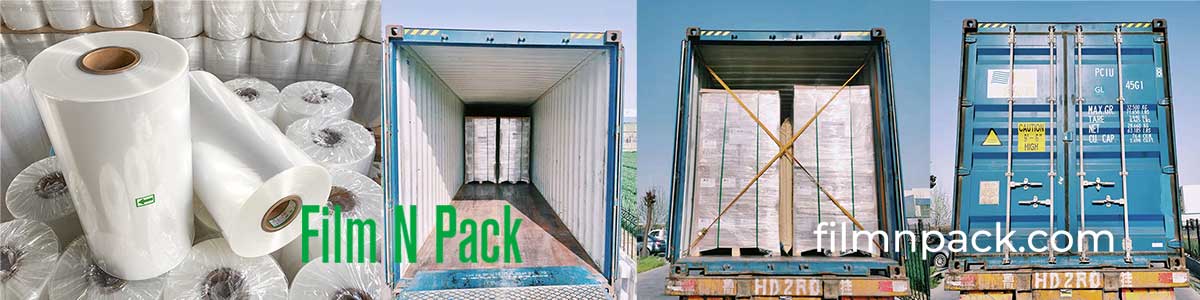
9 Steps of Polyolefin Shrink Film Manufacturing
POF shrink film can pack various kinds of food and non-food products. The main requirement for packaging and packaging method is the protection and preservation of the quality of the packaged product for a certain time (until the moment of its consumption). For these purposes, various techniques and methods are used, of which the most widely used is packaging in shrink films.
Step 1: Raw Materials Mix
Select plastic granules or resins in the right proportion. A typical polyolefin shrink film is a 3-layer or 5-layer structure: outer layer polypropylene, core layer polyethylene. Their thicknesses and weight ratios are about 30% and 70%.
Step 2: Granules Melting
Melting of the mixture granules at high temperature and pressure in extruders. If a 5-layer film structure, then five extruders in total. We, Filmnpack use dual-screw to achieve fine plasticization and crystallization rate, for better mechanical strength of the polyolefin shrink film.
Step 3: Thick Film Tube~ First Bubble
The melting granules then enter the annular co-extrusion die, sized and water quenched. In the first film bubble to form a thick primary plastic tube. The film tube’s thickness now can be about 300 microns to 500 microns.
Step 4: Orientation
Then re-heat the thick film tube by infrared rays to soften properly. Inflating cool air into the tube, and at the same time stretching it to the correct thickness and shrinkage, to form the second film bubble. During this process, polyolefin molecules are bidirectional stretching. Our film gauge uniformity can be the lowest plus or minus 5% of total film thickness. Compared with casting film, blown film has a more balanced MD-TD orientation.
Step 5: Cross-linking
The film exposes to electron beams, that is, radiation. The unconnected film molecules are reorganized into a three-dimensional structure and connected to each other.
Step 6: Jumbo Roll
The film exposes to electron beams, that is, radiation. The unconnected film molecules are reorganized into a three-dimensional structure and connected to each other.
Step 7: Sliting
The jumbo rolls or mother rolls are cut the edge to wanted width for the next step. The beaded films are removed, and sometimes these plastic scraps are recycled into raw materials.
Step 8: Winding
Installing the trimmed jumbo rolls into the slitter again, but smaller machine size. By applying proper stretching, rolling up the final films and having constant film tension. Depending on the type of winder of which the film using for, to produce the film into centerfold or single wound types.
Step 9: Packing
Putting core labels inside he finished film rolls and put them into the carton. We can preduce customized labels or printing carton to have your own brand image to customers. Then pilling up the film rolls into pallets, and ready for container loading.
Polyolefin Shrink Film Properties From Raw Materials
Pure granules or mixtures of various semi-finished products are the raw materials to manufacture polyolefin shrink films. These additives allow for obtaining specific film properties.
Polyethylene (PE) enables heat sealing and increases the mechanical resistance of the film.
Polypropylene (PP) provides high rigidity, high-temperature resistance, and excellent optical properties.
Copolymer of ethylene and vinyl acetate (EVA) strengthens the film and improves weldability and shrinkage.
Polyamide (PA) increases tear resistance and provides a gas barrier.
Ethyl vinyl alcohol (EVOH) improves the oxygen barrier.
Raw Materials for Polyolefin Shrink Film Manufacturing
The plastic materials polyethylene or polypropylene are the basis materials to manufacture polyolefin shrink films. Polyolefins are polymers containing only carbon and hydrogen, with long carbon chains -C-C-C-, constituting the basic backbone of the chains of the polymers themselves. We can say that polyolefins are polymeric hydrocarbons.
Polyolefins are a very important industrial group of polymers. The production of polyethylene and polypropylene accounts for about 80% of the weight of all synthetic polymers produced. These polymers have very good functional properties, the monomers for their production are obtained directly from crude oil, and their polymerization is not a major technical problem.
Polyethylene or Polyethene
A polymer of ethene, industrial symbol: (PE).
Polyethylene is flexible, waxy, transparent, and thermoplastic. It loses elasticity under the influence of sunlight and moisture. Polyethylene synthesis is an example of radical polymerization. The characteristic of PE films is its low permeability to water vapor, they easily pass vapors of organic substances, and they are not resistant to hydrocarbons and their chlorine derivatives. They are resistant to acid, alkali, and salt solutions as well as low temperatures.
HDPE (high density PE)
Low-pressure polymerization will obtain high density PE. It is harder than LDPE, has higher mechanical strength, higher melting point (125℃), higher gas barrier and higher chemical resistance, is more brittle at lower temperatures, and is less transparent (milky white). The most popular commercial grades of HDPE are PE 80 and PE 100. Density – 0.94-0.96 g/cm³.
LLDPE (linear low-density PE)
High-pressure linear low-density PE, is the short, unbranched chains. The result of the copolymerization of ethene with longer-chain alkenes) forms the LLDPE. It’s density – 0.915-0.935 g/cm³.
Polypropylene
A polymer from the group of polyolefins, built of units with the formula: -[CH2CH(CH3)]–. The result of low-pressure polymerization of propylene can obtain this polymer. Polypropylene is one of the two most commonly used plastics, next to polyethylene. The PP symbol is usually placed on items made of this material.
Polypropylene is a thermoplastic hydrocarbon polymer, i.e. it can be liquefied by increasing the temperature and solidified again by lowering it, without changing its chemical properties. PP is obtained by the polymerization of propene (commonly known as propylene, CH2=CHCH3), which is obtained from crude oil. Today, most polypropylene is produced in the Ziegler-Natta process, in the gas phase with the use of catalysts of organometallic compounds suspended on special substrates.
PP is the material with the lowest density among widely used polymers. It shows high chemical resistance, especially at room temperature, where it is almost completely resistant to acids, bases, salts, and organic solvents. Only strong oxidants, such as fuming sulfuric or nitric acid, bleaching bases and non-polar liquids (benzene, carbon tetrachloride, methyl chloride) attack it at this temperature. Long-term contact with copper also has a destructive effect on PP, therefore brass connectors should be used for permanent PP-copper connections.
POF Shrink Film Product Photo and Video
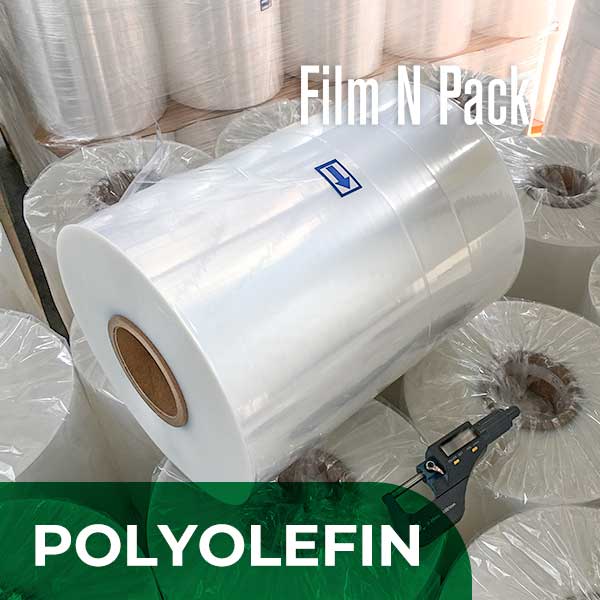


Polyolefin Shrink Film Manufacturer Supplier Factory
Polyolefin shrink film manufacturer, Filmnpack, is a high standards heat shrink packaging material product supplier in China. As a leading polyolefin packaging film supplier, we have 10 advanced blown film production lines with an annual output of up to 16,000 tons. We’re dedicated to offering a wide range of high quality polyolefin POF plastic shrink films to meet the diverse needs of buyers’ bulk purchase. All our polyolefin film products have been quality certified by international standards to ensure stable and reliable quality. Additionally, we focus on competitive prices, giving you great value for money with our cost-effective polyolefin packaging film products.
QUALITY POLYOLEFIN SHRINK FILM
packaging consultant
Custom heat shrink film
Recyclable Biodegradable
100% satisfaction guarantee
Contact Us
Our customer support team is available to help you 24/7
Phone/Whatsapp
(+86) 13953710086
Address
No.15 Industrial Park, Xipu Road, High New Zone, Jining, Shandong, China